Can Other People Hear Your Pillow Speaker at Night
Can other people hear your pillow speaker at night? The short answer is: it depends on several factors, including volume level, pillow type, and speaker placement. Most pillow speakers are designed to keep sound close to your ears, but thin pillows or high volumes can lead to sound leakage that your bed partner might notice. Understanding how these devices work and following a few simple tips can ensure private listening without disturbing anyone else in the room.
Have you ever wondered if the person sleeping next to you can hear what is coming through your pillow speaker? Maybe you love falling asleep to podcasts, audiobooks, or white noise, but you worry about keeping it quiet for your partner. You are not alone. This is one of the most common questions people ask before buying a pillow speaker for sleep. The good news is that most modern sleep audio devices are built with privacy in mind. But there are real factors that determine whether sound leaks out and disturbs others. In this guide, we will walk you through everything you need to know about pillow speaker privacy, sound leakage, and how to enjoy your bedtime audio without anyone else hearing it.
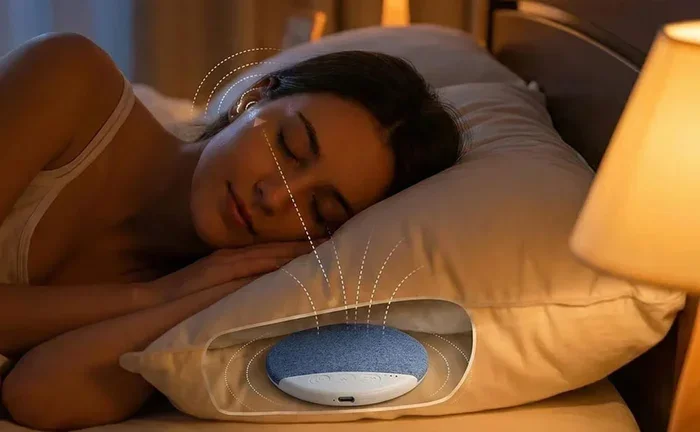
A pillow speaker is a small audio device that you place inside or on your pillow. It delivers sound directly to your ears while you lie in bed. Unlike headphones or earbuds, a pillow speaker does not go inside or over your ears. This makes it a popular choice for people who find earbuds uncomfortable during sleep. The device works by vibrating a thin membrane that pushes sound through the pillow material. The pillow then acts as a natural amplifier, directing the audio toward your head. This design keeps the sound close to your ears and away from anyone else in the bed. But does it work well enough to keep things completely private? Let us find out.
Key Takeaways
- Pillow speakers are designed for private listening: They rest inside your pillow and direct sound toward your ears, keeping audio mostly contained.
- Volume is the biggest factor: Higher volumes increase the chance that others nearby can hear what you are listening to.
- Pillow thickness matters a lot: Thin pillows allow more sound to escape compared to thick, dense pillows.
- Speaker placement affects privacy: Positioning the speaker correctly inside the pillow reduces sound leakage significantly.
- Wireless pillow speakers offer convenience: They eliminate tangled cords and give you freedom to move during sleep.
- Common mistakes increase sound leakage: Placing the speaker on top of the pillow or using it with a thin pillow are top errors.
- Follow simple tips for perfect privacy: Use a thick pillow, keep volume low, and position the speaker near your ear for the best results.
📑 Table of Contents
- Can Other People Really Hear Your Pillow Speaker?
- Factors That Affect Sound Leakage
- How to Keep Your Pillow Speaker Private
- Best Pillow Speakers for Zero Sound Leakage
- Common Mistakes People Make with Pillow Speakers
- Expert Tips for Perfect Private Listening
- Frequently Asked Questions
- Final Thoughts
Can Other People Really Hear Your Pillow Speaker?
The honest answer is yes and no. Whether someone else can hear your pillow speaker at night depends on a mix of factors. At low volumes, most people cannot hear it from across the room. But at higher volumes, or with the wrong setup, sound can definitely leak out. Let us break down the real possibilities so you know what to expect.
How Sound Travels Through Pillows
Sound moves through materials by vibrating the molecules in them. When your pillow speaker plays audio, it vibrates the pillow fabric and filling. Those vibrations carry the sound to the surface of the pillow. From there, some sound stays trapped inside the pillow, and some escapes into the air. Thick, dense pillows trap more sound. Thin, soft pillows let more sound pass through. This is why the type of pillow you use plays such a big role in sound isolation and privacy.
Another factor is the distance between the speaker and your ear. Most pillow speakers work best when they are placed right next to your ear, inside the pillow. If you push the speaker too far toward the center of the pillow, the sound has to travel through more material. This reduces leakage but can also make the audio quieter for you. Finding the sweet spot is key to both comfort and audio privacy.
What Your Bed Partner Might Hear
If your bed partner is lying right next to you, they might hear a faint sound, especially at higher volumes. What they hear usually sounds like a muffled version of the audio. It is rarely as clear as what you hear. Most people describe it as a soft whisper or a low hum. For many couples, this level of sound is perfectly acceptable and does not disrupt sleep. But if your partner is a very light sleeper, even a faint sound could be bothersome.
Here are some realistic scenarios of what your partner might hear:
- Low volume with a thick pillow: Almost nothing. Your partner is very unlikely to notice any sound at all.
- Medium volume with a standard pillow: A faint, muffled sound. Most people would not be disturbed by this.
- High volume with a thin pillow: A noticeable sound. Your partner might hear words or music clearly enough to be distracted.
- Any volume with no pillow: The speaker is exposed, and sound travels freely. This is the worst case for privacy.
Factors That Affect Sound Leakage
Not all pillow speaker setups are the same. Several factors determine how much sound escapes and whether others can hear it. Understanding these factors helps you make smart choices about how you use your device at night.
Volume Level
Volume is the single biggest factor in sound leakage. The louder your speaker, the more sound energy pushes through the pillow and into the air. At low volumes, the vibrations are small and stay mostly contained within the pillow. At high volumes, the vibrations are strong enough to push sound past the pillow surface and into the room. This is why keeping the volume low is the easiest and most effective way to maintain sleep audio privacy.
A good rule of thumb is to set the volume at the lowest level where you can still hear and enjoy the audio clearly. If you need to raise the volume to hear over background noise, consider switching to a speaker with better sound isolation or using noise-canceling features on your audio source.
Pillow Type and Thickness
The pillow you use matters more than you might think. A thick, memory foam pillow does a much better job of trapping sound than a thin, flat pillow. Here is why:
- Thick pillows have more material for the sound to travel through before reaching the surface. This absorbs more audio energy and reduces leakage.
- Memory foam pillows are especially good because the dense foam absorbs vibrations rather than letting them pass through.
- Thin pillows or flat pillows let sound pass through quickly with little absorption. This increases the chance that others can hear your audio.
- Buckwheat hull pillows are another great option. The natural filling absorbs sound well and conforms to the shape of the speaker and your head.
If you are serious about private nighttime listening, investing in a thick, high-quality pillow can make a big difference. It is one of the simplest and most affordable upgrades you can make.
Speaker Placement
Where you place the pillow speaker inside the pillow changes everything. If you lay the speaker on top of the pillow, sound escapes easily. If you tuck it inside the pillow near your ear, the pillow material blocks most of the sound. The best placement is usually about two to three inches from your ear, buried inside the pillow filling. This gives you clear audio while keeping the sound contained.
Some wireless pillow speakers come with a pocket or sleeve that holds the speaker in place. These are very helpful because they prevent the speaker from shifting around during the night. If your speaker does not have a built-in pocket, you can wrap it in a small cloth or sock before placing it inside the pillow. This helps with both placement and sound absorption.
Room Acoustics
The room you sleep in also plays a role. A room with soft furnishings like curtains, carpets, and upholstered furniture absorbs sound better than a room with hard surfaces like tile floors and bare walls. If your bedroom has hard surfaces, sound may bounce around and travel farther. This does not mean you need to redecorate your room, but it is worth knowing that room acoustics can affect how far your sleep audio travels.
How to Keep Your Pillow Speaker Private
Want to enjoy your bedtime listening without worrying about anyone else hearing it? Follow these practical tips to keep your audio completely private.
1. Keep the Volume Low
This is the simplest and most important tip. Start with the volume at the lowest setting and increase it only until you can hear comfortably. Most people find that a volume setting of 30 to 40 percent is plenty for a quiet bedroom. Keeping the volume low not only protects your audio privacy but also supports better sleep hygiene. Loud audio right before bed can actually disrupt your sleep quality, even if you do not realize it.
2. Use a Thick, Dense Pillow
As we discussed, pillow thickness is a major factor. Choose a pillow that is at least 5 to 6 inches thick when flattened. Memory foam and buckwheat hull pillows are excellent choices. Avoid thin, flat pillows if privacy is a concern. The extra material absorbs more sound and keeps your pillow speaker audio close to your ears.
3. Bury the Speaker Inside the Pillow
Do not leave the speaker sitting on top of the pillow. Tuck it deep inside the filling, close to your ear. The more pillow material between the speaker and the open air, the less sound escapes. If your speaker has a fabric sleeve or case, use it. This adds an extra layer of sound absorption and also keeps the speaker from shifting during the night.
4. Use Noise-Masking Background Sound
If you are worried about the faintest sound leaking out, try playing a layer of white noise or brown noise along with your audio. The masking sound covers up any leakage so that even if a small amount of sound escapes, it blends into the background noise and becomes inaudible. Many pillow speaker apps and devices let you mix your audio with background sounds for this exact purpose.
5. Choose a Speaker Designed for Privacy
Not all sleep speakers are created equal. Some are specifically engineered to minimize sound leakage. Look for speakers that use bone conduction technology or speakers with a directed sound output. These designs focus the audio toward your ears and reduce the amount of sound that spreads outward. Reading reviews and checking product specifications can help you find a pillow speaker that prioritizes privacy.
6. Communicate with Your Bed Partner
This might sound obvious, but it is worth mentioning. Talk to your partner about your bedtime listening habits. Ask if they can hear anything. If they say yes, work together to find a solution. Maybe they need a different pillow position, or maybe you need to lower the volume. Open communication solves most sleep audio issues before they become a problem.
Best Pillow Speakers for Zero Sound Leakage
If you are in the market for a new pillow speaker, some models do a better job of keeping sound private than others. Here are a few features to look for when choosing a speaker that minimizes sound leakage.
Features That Reduce Sound Leakage
- Bone conduction technology: These speakers transmit sound through vibrations directly to your skull, bypassing the air entirely. Very little sound leaks into the room.
- Directed audio output: Some speakers focus the sound in one direction, toward your ear, rather than spreading it evenly.
- Built-in volume limiting: Speakers with capped maximum volumes naturally reduce the risk of sound leakage.
- Soft, fabric-covered design: Speakers wrapped in soft fabric absorb more vibrations and produce less airborne sound.
- Low-power drivers: Speakers designed for sleep use typically have lower-powered drivers that produce just enough sound for private listening without excess noise.
Comparison of Popular Pillow Speakers
Here is a quick look at how some popular pillow speakers compare when it comes to sound leakage and privacy:
- Pillow Speaker A (Basic Model): Affordable and simple. Works well at low volumes but leaks more sound at higher volumes. Best for people who keep the volume low.
- Pillow Speaker B (Bone Conduction): Uses vibrations to deliver sound directly to the inner ear. Very little sound leaks into the room. Excellent for audio privacy.
- Pillow Speaker C (Wireless with App Control): Connects to your phone via Bluetooth. Offers volume limiting and white noise mixing. Great all-around option for couples.
- Pillow Speaker D (Ultra-Thin Design): Very flat and fits easily inside any pillow. Good sound quality but moderate leakage. Best paired with a thick pillow.
Common Mistakes People Make with Pillow Speakers
Even with the best intentions, many people make mistakes that increase sound leakage and reduce their sleep audio privacy. Here are the most common errors and how to avoid them.
Placing the Speaker on Top of the Pillow
This is the number one mistake. When the speaker sits on top of the pillow, there is almost no material between the speaker and the air. Sound escapes freely, and anyone nearby can hear it clearly. Always place the speaker inside the pillow, buried in the filling, for the best sound isolation.
Using a Thin or Flat Pillow
Thin pillows simply cannot absorb much sound. If you sleep on a flat pillow, the speaker vibrations pass right through to the surface and into the room. If you prefer a thin pillow for comfort, consider using a pillow speaker with bone conduction technology, which does not rely on the pillow for sound containment.
Setting the Volume Too High
It is tempting to turn up the volume, especially if you are listening to a podcast or audiobook that you want to stay engaged with. But high volume is the fastest way to lose audio privacy. Keep it low. If you struggle to hear at low volumes, try a speaker with better sound projection rather than turning up the volume.
Ignoring Speaker Placement Over Time
During the night, you naturally shift positions and the speaker can move. By morning, it might be sitting on top of the pillow or pushed far away from your ear. This means you are waking up with inconsistent sound leakage throughout the night. Using a speaker with a built-in pocket or wrapping it in a cloth helps keep it in place.
Expert Tips for Perfect Private Listening
Sleep specialists and audio engineers share a few insights that can take your pillow speaker experience to the next level. Here is what the experts recommend for the best private listening setup.
Use a Dual-Layer Pillow Setup
Some people place the speaker inside a small cloth pouch, then tuck that pouch inside the pillow. This double-layer setup adds extra sound absorption and is one of the most effective ways to eliminate sound leakage. It costs nothing extra and works with any pillow type.
Pair Your Speaker with a Sleep Timer
Many pillow speaker apps and devices let you set a sleep timer. This means the audio gradually fades out and stops after a set period. This is great for sleep hygiene because it prevents audio from playing all night and potentially disturbing your partner if you happen to shift positions during the night.
Test Your Setup Before Your Partner Wakes Up
Try your pillow speaker setup during a nap or while your partner is awake. Ask them if they can hear anything. This quick test helps you adjust the volume, speaker position, or pillow type before it becomes a nighttime issue. A little testing goes a long way toward ensuring audio privacy every single night.
Keep Your Speaker Clean
Dust and sweat can build up on your pillow speaker over time, affecting its performance. A dirty speaker may produce distorted sound, which might tempt you to raise the volume. Clean your speaker regularly with a soft, damp cloth. Check the manufacturer’s instructions for the best cleaning method. A clean speaker performs better and helps you maintain that low volume for private listening.
Frequently Asked Questions
Can my partner hear my pillow speaker if I keep the volume at 50 percent?
It depends on your pillow type and speaker placement. At 50 percent volume with a thick pillow and the speaker buried inside, most partners hear only a faint, muffled sound. With a thin pillow or the speaker placed on top, the sound becomes much more noticeable. For the best privacy, keep the volume below 40 percent and always bury the speaker inside the pillow.
Are bone conduction pillow speakers completely silent to others?
Bone conduction speakers are the best option for audio privacy because they transmit sound through vibrations to your skull rather than through the air. However, at very high volumes, a faint sound can still escape from the speaker itself. At normal listening volumes, they are essentially silent to anyone else in the room.
What type of pillow is best for hiding pillow speaker sound?
Thick memory foam pillows and buckwheat hull pillows are the best choices. They absorb sound vibrations and prevent them from reaching the pillow surface. Avoid thin, flat pillows or pillows filled with loose polyester if privacy is your main concern.
Can my roommate hear my pillow speaker through the wall?
If you are in a different room, the answer is almost always no. Sound from a pillow speaker is very localized and does not travel well through walls. Even in the same room, a roommate on the other side would need to be very close and the volume would need to be quite high for them to hear anything.
Is it safe to use a pillow speaker every night?
Yes, pillow speakers are generally safe for nightly use. They do not emit harmful radiation and the volume levels used for sleep are well within safe hearing limits. Just make sure to keep the volume at a comfortable, low level to protect your hearing over time and maintain good sleep hygiene.
How do I know if my pillow speaker is leaking sound?
The simplest test is to have someone else in the room listen while you play audio at your normal volume. If they can hear it, try burying the speaker deeper in the pillow, lowering the volume, or switching to a thicker pillow. Most sound leakage issues can be fixed with these simple adjustments.
Final Thoughts
So, can other people hear your pillow speaker at night? The answer is that it is entirely within your control. With the right volume, the right pillow, and proper speaker placement, you can enjoy private sleep audio without disturbing anyone else in the room. Pillow speakers are designed with privacy in mind, and by following the tips in this guide, you can make sure they do their job effectively.
Remember to keep the volume low, use a thick and dense pillow, bury the speaker inside the filling, and communicate with your bed partner. These small steps make a huge difference in keeping your bedtime listening completely private. Whether you enjoy podcasts, audiobooks, white noise, or guided meditation, a pillow speaker can transform your sleep routine when used correctly. Now you have all the knowledge you need to enjoy your audio privately and rest peacefully through the night.