Can You 3d Print A Car Engine And What It Really Takes
Yes, you can 3d print a car engine, but it is not as simple as pressing a button. It requires industrial-grade additive manufacturing, specialized metal powders, and serious engineering know-how. This guide breaks down the real process, costs, and challenges involved in 3d printing a car engine so you know exactly what to expect.
Can you 3d print a car engine? The short answer is yes. But the real question is, what does it actually take to pull it off? If you have ever wondered about 3d printing a car engine, you are not alone. This topic has exploded in recent years, and for good reason. The idea of building a working engine from scratch using nothing but a printer sounds like science fiction. Yet it is very much science fact today.
The world of additive manufacturing has come a long way. What was once limited to plastic prototypes now includes full metal parts that can handle extreme heat and pressure. Car manufacturers and hobbyists alike are exploring what 3d printing technology can do for engines. In this article, we will walk you through everything you need to know. From the types of printers used to the materials, costs, and real-world challenges, we have you covered.
Key Takeaways
- 3d printing a car engine is possible using advanced metal 3d printing technologies like SLM and EBM.
- Industrial-grade printers and expensive materials are required, making it a significant investment.
- Engine components like blocks, pistons, and manifolds can be printed individually and assembled.
- Time and cost vary widely depending on engine size, material, and printer capability.
- Rapid prototyping is the biggest current use case for 3d printed engine parts in the automotive industry.
- Strength and durability of 3d printed metal parts can match or exceed traditional manufacturing in many cases.
- Future of automotive 3d printing looks bright with ongoing advances in speed, materials, and scale.
📑 Table of Contents
- What Does It Mean to 3d Print a Car Engine?
- Can You Actually 3d Print a Working Car Engine?
- What Technology Is Used to Print Engine Parts?
- What Materials Are Used for 3d Printed Engine Parts?
- What Does It Cost and How Long Does It Take?
- Challenges and Limitations of 3d Printing Car Engines
- The Future of 3d Printed Car Engines
- Key Takeaways
- Conclusion
What Does It Mean to 3d Print a Car Engine?
When we talk about 3d printing a car engine, we are referring to the process of building engine parts layer by layer using digital designs. This is also known as additive manufacturing. Instead of cutting away material from a solid block, a printer adds material exactly where it is needed. This approach opens up possibilities that traditional machining simply cannot match.
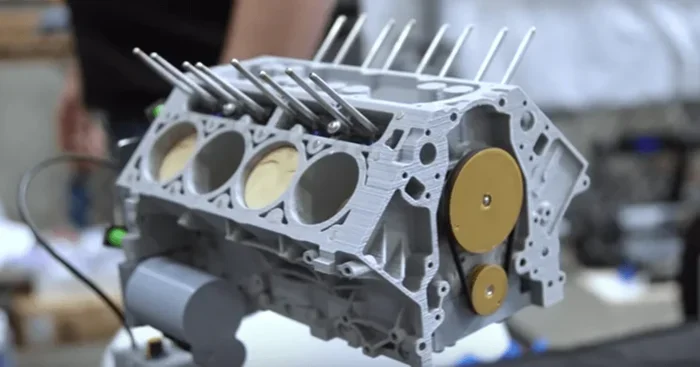
Now, you cannot print an entire engine as one single piece. At least, not yet with current technology. What happens instead is that individual engine components are printed separately and then assembled. Think of it like building with LEGO bricks, except each brick is a precision-made metal part designed to handle thousands of revolutions per minute.
How 3d Printing Differs from Traditional Manufacturing
Traditional engine manufacturing relies on casting, forging, and machining. These methods have been refined over decades. They work well for mass production. But they come with limitations. Complex internal geometries are hard or impossible to achieve. Rapid prototyping, on the other hand, thrives on complexity. A 3d printed engine part can include internal cooling channels, lattice structures, and organic shapes that improve performance.
Here is a simple way to think about it. Traditional manufacturing is like sculpting from a block of stone. You remove what you do not need. Additive manufacturing is like building up layer by layer, adding only what is required. This fundamental difference changes everything about design freedom.
Can You Actually 3d Print a Working Car Engine?
The honest answer is yes, people have done it. Several companies and independent builders have successfully 3d printed a car engine that runs. These are not just show pieces sitting on a shelf. They are functional engines that produce real power. However, there is a big catch. The process is complex, expensive, and requires expertise in both engineering and 3d printing technology.
Most successful projects focus on smaller engines first. A single-cylinder test engine is a common starting point. From there, builders scale up to multi-cylinder configurations. The key is ensuring every printed part meets strict tolerances for fit, strength, and heat resistance.
Real-World Examples of 3d Printed Engines
Several notable projects have proven that 3d printed car engines are more than just a concept. Some companies have printed complete engine blocks using metal 3d printing processes. Others have focused on specific components like cylinder heads, intake manifolds, or piston assemblies. Each project pushes the boundaries of what is possible with industrial 3d printers.
One exciting example comes from the automotive racing world. Teams use rapid manufacturing to create lightweight, high-performance engine parts for competitive vehicles. These parts are tested under extreme conditions and often outperform their traditionally manufactured counterparts. This is a strong signal that 3d printed engine parts are not just experimental. They are becoming practical.
What Technology Is Used to Print Engine Parts?
The technology behind 3d printing a car engine is sophisticated. Not all printers can handle the job. You need machines designed for metal additive manufacturing that can reach the temperatures and precision required for engine-grade parts.
Selective Laser Melting (SLM)
Selective Laser Melting, or SLM, is one of the most popular methods for printing metal engine parts. A high-powered laser melts metal powder layer by layer to build up a solid part. SLM offers excellent detail and strong mechanical properties. It is widely used in aerospace and automotive rapid prototyping.
The laser precision allows for incredibly thin walls and complex internal structures. This is perfect for engine components where weight reduction and heat management are critical. The downside is cost. SLM machines are expensive, and the process is relatively slow.
Electron Beam Melting (EBM)
Electron Beam Melting uses an electron beam instead of a laser to melt metal powder. EBM works well for larger parts and can be faster than SLM in some cases. It is another popular choice for production-grade 3d printing of engine components. The process takes place in a vacuum, which prevents contamination of the metal.
EBM parts tend to have slightly different surface finishes compared to SLM. But for many engine applications, the mechanical strength is excellent. Both SLM and EBM fall under the broader category of metal 3d printing, and both are capable of producing functional engine parts.
Binder Jetting and Other Emerging Methods
Binder Jetting is a newer approach that uses a binding agent to join metal powder particles. After printing, the part goes through a sintering process to achieve full density. This method can be faster and more cost-effective for certain applications. It is gaining traction in the automotive 3d printing space.
Other methods like Directed Energy Deposition (DED) are also used for large-scale engine parts. DED can repair or add material to existing components, which is useful for legacy engine restoration. The landscape of 3d printing materials and methods continues to evolve rapidly.
What Materials Are Used for 3d Printed Engine Parts?
The material you choose makes all the difference when 3d printing a car engine. Engine parts face extreme conditions. They must withstand high temperatures, intense pressure, and constant vibration. Not every 3d printing material can handle this. Here are the most common options.
Stainless Steel
Stainless steel is a popular choice for 3d printed engine components. It offers good strength, excellent corrosion resistance, and can handle moderate temperatures. Many engine brackets, housings, and structural parts are printed in stainless steel. It is also relatively affordable compared to other metals used in additive manufacturing.
Inconel and Superalloys
For parts that face extreme heat, such as exhaust manifolds or turbine sections, Inconel is a top choice. This nickel-based superalloy maintains its strength at very high temperatures. It is commonly used in aerospace and high-performance automotive applications. 3d printing with Inconel produces parts that rival or exceed the performance of traditionally manufactured equivalents.
Aluminum Alloys
Aluminum is lightweight and conducts heat well, making it ideal for engine blocks and cylinder heads. Certain aluminum alloys are specifically formulated for metal 3d printing. They offer good thermal conductivity and are relatively easy to machine after printing. Lightweight engine parts contribute to better fuel efficiency and overall engine performance.
Titanium
Titanium offers an exceptional strength-to-weight ratio. It is used in high-end racing and performance applications where every gram matters. 3d printing titanium parts for engines is expensive but yields outstanding results. The material is also biocompatible and highly corrosion-resistant, though cost remains the biggest barrier.
| Material | Best For | Strength | Heat Resistance | Cost Level |
|---|---|---|---|---|
| Stainless Steel | Brackets, housings, structural parts | High | Moderate | Low to Medium |
| Inconel | Exhaust manifolds, high-heat parts | Very High | Excellent | High |
| Aluminum Alloys | Engine blocks, cylinder heads | Moderate to High | Good | Medium |
| Titanium | Racing components, lightweight parts | Very High | Good | Very High |
What Does It Cost and How Long Does It Take?
Cost and time are the biggest practical questions around 3d printing a car engine. The answers can surprise you. Let us break it down so you have a realistic picture.
Cost Breakdown
The cost of 3d printing engine parts varies enormously. It depends on the material, the printer, the part complexity, and the quantity. Here are some rough estimates to give you a sense of scale.
- Small engine components like brackets or sensor mounts: $50 to $500 per part.
- Medium parts like cylinder heads or intake manifolds: $500 to $5,000 per part.
- Large components like a full engine block: $5,000 to $50,000 or more.
- Industrial metal printers used for this work: $500,000 to over $1 million.
- Metal powder materials can cost $50 to $500 per kilogram depending on the alloy.
As you can see, 3d printing a complete car engine from scratch is a major financial undertaking. This is why most projects focus on specific components rather than entire engines. The cost of the printer alone makes full engine production impractical for most individuals and small shops.
Time Required
Time depends on part size, printer speed, and post-processing needs. A small bracket might print in a few hours. A complex cylinder head could take several days. A full engine block might require weeks of printing time, plus additional time for heat treatment, machining, and surface finishing.
Rapid prototyping is where 3d printing really shines in terms of speed. Designers can go from digital model to physical part in days instead of weeks. This acceleration in the development cycle is one of the biggest advantages of additive manufacturing in the automotive sector.
Challenges and Limitations of 3d Printing Car Engines
Despite the exciting progress, there are real challenges when it comes to 3d printing a car engine. Understanding these limitations is just as important as knowing the possibilities.
Strength and Fatigue Concerns
Engine parts face constant stress, heat cycles, and vibration. Traditional manufacturing methods like casting and forging have been optimized over decades to handle these forces. 3d printed metal parts can match or exceed these properties, but only when the printing parameters and post-processing are carefully controlled. Porosity, weak layer bonding, and residual stress are real concerns that engineers must address.
Surface Finish and Post-Processing
Most 3d printed engine parts require significant post-processing. Support structures must be removed. Surfaces must be machined to achieve proper tolerances. Heat treatment is often needed to relieve internal stresses and improve mechanical properties. This adds time and cost to the overall process.
Size Limitations of Printers
Not every industrial 3d printer can accommodate large engine parts. Build volumes are limited, which means very large components may need to be printed in sections and then joined. This introduces additional complexity and potential weak points in the final assembly.
Material Availability and Consistency
The quality of 3d printing materials can vary between suppliers. Consistency in powder particle size, composition, and flowability directly affects print quality and part reliability. For mission-critical engine components, material certification and traceability are essential.
The Future of 3d Printed Car Engines
The future of automotive 3d printing is incredibly promising. Technology is advancing rapidly, and each year brings new capabilities that push the boundaries of what is possible.
Faster Printers and Larger Build Volumes
Manufacturers are developing faster metal 3d printers with larger build volumes. This directly addresses two of the biggest current limitations: speed and size. As these machines improve, the economics of 3d printing a car engine will become more favorable.
New Materials and Alloys
Research into new 3d printing materials is ongoing. Engineers are developing specialized alloys designed specifically for additive manufacturing. These materials offer improved strength, better thermal properties, and greater consistency. Some are even designed to be printed and used without extensive post-processing.
Integration with Traditional Manufacturing
The most practical near-term future likely involves hybrid approaches. Combining 3d printed components with traditionally manufactured parts offers the best of both worlds. You get the design freedom and complexity of additive manufacturing where it matters most, while relying on proven traditional methods for simpler components.
Custom and Performance Engines
One of the most exciting applications is in custom and high-performance engines. Enthusiasts and small manufacturers can use 3d printing technology to create unique engine designs that would be impossible or prohibitively expensive with traditional methods. This opens the door to a new era of personalized automotive engineering.
Key Takeaways
- 3d printing a car engine is possible using advanced metal 3d printing technologies like SLM and EBM.
- Industrial-grade printers and expensive materials are required, making it a significant investment.
- Engine components like blocks, pistons, and manifolds can be printed individually and assembled.
- Time and cost vary widely depending on engine size, material, and printer capability.
- Rapid prototyping is the biggest current use case for 3d printed engine parts in the automotive industry.
- Strength and durability of 3d printed metal parts can match or exceed traditional manufacturing in many cases.
- Future of automotive 3d printing looks bright with ongoing advances in speed, materials, and scale.
Conclusion
So, can you 3d print a car engine? Absolutely. The technology exists today, and real working engines have been built using additive manufacturing. But it is not a casual weekend project. It requires industrial-grade equipment, specialized materials, and deep engineering expertise. The cost and time involved are significant, especially for a complete engine.
That said, the landscape is changing fast. 3d printing technology continues to advance, and costs are gradually coming down. What is currently possible only for large manufacturers and well-funded projects will become more accessible in the years ahead. If you are interested in 3d printed engine parts, start small. Try printing a bracket, a manifold, or a prototype component. Build your knowledge and skills from there.
The world of automotive 3d printing is exciting, and we are only at the beginning. Whether you are a professional engineer, a hobbyist, or simply curious, understanding what it takes to 3d print a car engine gives you a window into the future of manufacturing. The possibilities are real, and they are closer than you might think.
FAQs
Can a regular 3d printer print a car engine?
No, a regular consumer 3d printer cannot print a car engine. These printers are designed for plastic materials and lack the temperature control, precision, and build volume needed for metal engine parts. You need an industrial-grade metal 3d printer for that kind of work.
How long does it take to 3d print a car engine?
The time varies widely depending on the engine size and printer capability. A small test engine might take a few weeks to print all the parts. A full-size car engine could take several months when you include printing, post-processing, machining, and assembly. Rapid prototyping is much faster for smaller components.
Is 3d printing a car engine expensive?
Yes, it can be very expensive. Industrial metal printers cost hundreds of thousands to over a million dollars. Materials like Inconel and titanium are pricey. However, costs are decreasing as the technology matures. For individual components, costs are more manageable and can range from hundreds to thousands of dollars.
What materials are best for 3d printing engine parts?
The best material depends on the application. Stainless steel is great for structural parts and brackets. Inconel excels in high-heat areas like exhaust manifolds. Aluminum alloys work well for blocks and heads due to their light weight and thermal conductivity. Titanium is ideal for racing applications where weight savings are critical.
Are 3d printed engine parts as strong as traditionally manufactured ones?
In many cases, yes. Properly printed and post-processed metal parts can match or even exceed the strength of traditionally manufactured components. However, this depends heavily on the printing parameters, material quality, and post-processing steps like heat treatment and machining. Quality control is essential.
Will 3d printed car engines become common in the future?
It is very likely. As printers get faster, materials improve, and costs decrease, 3d printing will become a standard tool in automotive manufacturing. We will probably see more hybrid approaches where some parts are printed and others are traditionally manufactured. Full 3d printed engines for mass production are still a few years away but are being actively researched and developed.