Are 3m Worktunes OSHA Approved What You Need to Know
Are 3M Worktunes OSHA approved? These popular hearing protection devices are designed to meet key workplace safety standards and deliver strong noise reduction. While they carry ANSI certifications and provide solid decibel protection, they are not officially “OSHA approved” as a single product. This guide breaks down what OSHA really requires, how 3M Worktunes perform, and whether they are the right choice for your job.
Are 3M Worktunes OSHA approved? This is a question that comes up constantly among workers, safety managers, and anyone shopping for hearing protection gear. The answer is not as simple as yes or no, and that is exactly why this guide exists. Whether you work on a construction site, in a factory, or anywhere loud noise is part of the daily routine, understanding what OSHA really requires can save your hearing.
3M Worktunes are some of the most popular electronic earmuffs on the market today. They combine noise reduction with Bluetooth connectivity, which makes them appealing for workers who want both safety and convenience. But popularity does not always mean compliance. That is why it is so important to dig into the details and understand what OSHA standards really demand from hearing protection devices.
In this article, we will walk through everything you need to know. We will cover what OSHA actually requires, how 3M Worktunes measure up, and what to look for when choosing hearing protection for your workplace. By the end, you will have a clear picture of whether these earmuffs are the right fit for your job and your safety needs.
Key Takeaways
- OSHA Does Not Approve Products: OSHA sets safety standards and regulations, but it does not officially approve or certify individual products like 3M Worktunes.
- ANSI Certification Matters: 3M Worktunes meet ANSI S3.19 standards for noise reduction, which aligns with OSHA workplace requirements and hearing conservation programs.
- Strong NRR Ratings: With a noise reduction rating of 24 to 29 depending on the model, these earmuffs provide solid decibel protection for loud work environments.
- Bluetooth Adds Convenience: The Bluetooth hearing protection feature lets workers stay connected and enjoy audio without removing their safety gear.
- Best for Moderate to High Noise: 3M Worktunes work well in construction, manufacturing, and other noisy industries where hearing damage prevention is critical.
- Comfort Matters for All-Day Use: The padded headband and adjustable design make them suitable for long shifts without causing fatigue.
- Check Your Workplace Requirements: Always verify your specific OSHA noise exposure limits before choosing any hearing protection device for your job.
📑 Table of Contents
What Are 3M Worktunes?
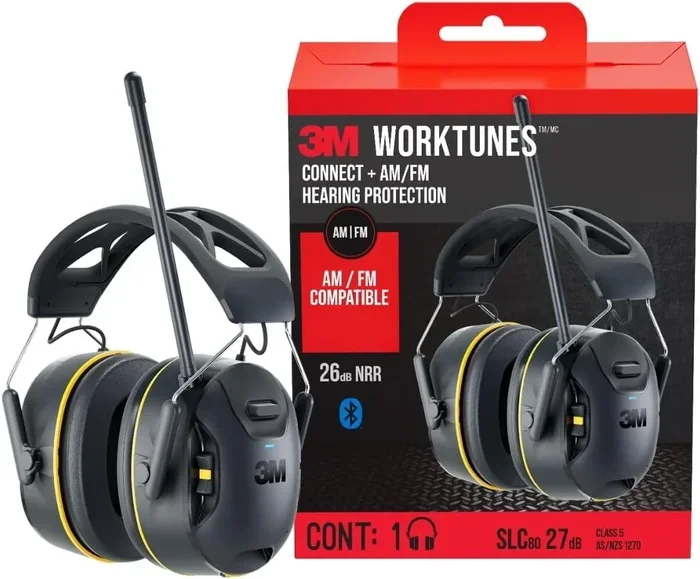
3M Worktunes are a line of electronic earmuffs designed to protect your ears from loud noise while also allowing you to listen to audio. They are part of 3M’s broader hearing conservation product family. These devices are widely used in construction, manufacturing, landscaping, and other industries where noise levels can exceed safe limits.
Unlike regular foam earplugs, 3M Worktunes use electronic technology to reduce harmful noise. At the same time, they allow lower-level sounds like speech or music to pass through. This makes them a popular choice for workers who need to communicate on the job but still need serious decibel protection.
How Do 3M Worktunes Work?
The technology behind 3M Worktunes is straightforward but effective. The earmuffs contain microphones that pick up ambient sound. Then, the electronics filter out dangerous noise levels while amplifying safe sounds. This process happens in real time, so you stay aware of your surroundings without exposing your ear canal to harmful decibels.
Most models also include a Bluetooth connection. This lets you pair your phone or music player directly to the earmuffs. You can listen to music, take calls, or hear instructions from a supervisor without ever taking off your safety gear. That combination of protection and connectivity is what sets 3M Worktunes apart from basic passive earmuffs.
Different Models in the 3M Worktunes Line
3M offers several versions of the Worktunes series. The 3M Worktunes Connect model is one of the most popular. It features Bluetooth 4.1, an NRR of 24 dB, and adjustable volume controls. The 3M Worktunes Amplify is another well-known option. It offers a higher NRR of 29 dB and includes directional microphones for better sound awareness.
Each model is designed for different noise environments. The Worktunes Connect works well in moderately noisy settings. The Amplify version is better suited for louder industrial environments. Choosing the right model depends on your specific noise exposure levels and job requirements.
Understanding OSHA Requirements for Hearing Protection
Before we answer whether 3M Worktunes are OSHA approved, it helps to understand what OSHA actually requires. The Occupational Safety and Health Administration sets the rules for workplace safety in the United States. When it comes to noise exposure, OSHA has clear standards that employers must follow.
What OSHA Says About Noise Exposure
OSHA’s permissible exposure limit, or PEL, is 90 decibels averaged over an 8-hour workday. If noise levels exceed this limit, employers must implement a hearing conservation program. This program includes providing proper PPE, such as earmuffs or earplugs, to all affected workers.
The key thing to understand is that OSHA does not approve or certify specific products. Instead, OSHA sets the standards that products must meet. Employers are responsible for selecting hearing protection that complies with those standards. This is where ANSI certification comes into play.
What Is ANSI Certification?
The American National Standards Institute, or ANSI, develops safety standards for products like hearing protection. The most relevant standard for earmuffs is ANSI S3.19. This standard measures the noise reduction rating, or NRR, of a device. When a product is ANSI rated, it means it has been tested and meets specific performance criteria.
OSHA recognizes ANSI-rated products as acceptable for workplace use. So while OSHA does not “approve” 3M Worktunes directly, it does accept products that meet ANSI standards. This is a crucial distinction that many people overlook when shopping for safety gear.
Why NRR Matters for Your Safety
The noise reduction rating tells you how much sound a device blocks. A higher NRR means more protection. For example, if your workplace measures 100 decibels and you wear earmuffs with an NRR of 24, the effective noise level reaching your ears drops to about 76 decibels. That is a significant reduction and well within safe limits.
OSHA requires that hearing protection bring noise exposure down to 85 decibels or below. This is the action level where hearing conservation programs must be implemented. So when you are choosing between products, always check the NRR and calculate whether it meets your workplace needs.
Are 3M Worktunes OSHA Approved? The Real Answer
Now let us get to the heart of the question. Are 3M Worktunes OSHA approved? The direct answer is no. OSHA does not approve or certify individual products. What OSHA does is set exposure limits and require employers to provide adequate hearing protection. Products that meet ANSI standards are considered compliant with OSHA regulations.
3M Worktunes carry ANSI S3.19 certification. This means they have been independently tested and verified to deliver the noise reduction claimed on the packaging. For employers and workers, this is what matters most. A product does not need an “OSHA approved” stamp to be compliant. It needs to meet the established safety standards.
What OSHA Approval Actually Means
There is a common misconception that OSHA approves products the way the FDA approves medications. That is not how it works. OSHA is a regulatory agency. It creates and enforces safety standards. It does not test or certify products. Instead, OSHA relies on third-party testing organizations like ANSI to verify product performance.
So when you see a product marketed as “OSHA approved,” that is technically misleading. What the manufacturer means is that the product meets OSHA-aligned standards. Always look for ANSI certification and check the NRR rating. Those are the real indicators of compliance.
ANSI Standards vs OSHA Approval
Understanding the difference between ANSI standards and OSHA approval is essential for making informed decisions. ANSI tests products for performance. OSHA sets the rules for how those products must be used in the workplace. Both are important, but they serve different purposes.
When you buy 3M Worktunes, you are getting an ANSI-certified product. When your employer provides them, they are meeting OSHA requirements for PPE. Together, these two things ensure that your hearing protection is both effective and regulation-compliant.
Key Features That Make 3M Worktunes Stand Out
Now that you understand the regulatory side, let us look at what makes 3M Worktunes a strong choice for hearing protection. These earmuffs are packed with features designed for real-world job sites and industrial environments.
Noise Reduction Rating
The NRR is the most important spec for any hearing protection device. 3M Worktunes offer NRR values ranging from 24 to 29 dB depending on the model. This puts them in the upper range of electronic earmuffs. For most construction and manufacturing environments, this level of noise reduction is more than sufficient.
It is worth noting that the real-world NRR is often lower than the lab-tested value. OSHA provides a formula to estimate real-world performance. You subtract 7 from the listed NRR and then divide by 2. So an NRR of 24 becomes an effective protection of about 8.5 dB. This is still meaningful and helps bring noise levels into a safer range.
Bluetooth and Connectivity
One of the biggest selling points of 3M Worktunes is the Bluetooth capability. You can pair your smartphone directly to the earmuffs and listen to music or take calls. This is a game-changer for workers who spend long hours on repetitive tasks. Music or podcasts can make the workday more enjoyable without compromising safety.
The Bluetooth connection also supports two-way communication. You can hear a coworker speaking to you or receive audio instructions from a supervisor. The electronic amplification in 3M Worktunes is designed to boost these lower-level sounds while still blocking dangerous noise. This dual function is what makes them so versatile.
Comfort and Design
Comfort is often overlooked when people shop for hearing protection, but it matters a lot. If your earmuffs hurt after an hour, you will stop wearing them. 3M Worktunes are designed with a padded headband and cushioned ear cups. The weight is distributed evenly, which reduces pressure points during long shifts.
The adjustable headband fits a range of head sizes. The ear cups swivel slightly, which makes it easy to find a comfortable position. For workers who wear safety glasses at the same time, 3M Worktunes are designed to work well with most frames. This compatibility is a practical advantage on busy job sites.
Battery Life and Durability
Electronic earmuffs need power to function. 3M Worktunes use replaceable batteries that provide long run times. Most models offer several hours of continuous use on a single charge or set of batteries. This is important for workers who need all-day protection without worrying about the device dying mid-shift.
The build quality of 3M Worktunes is solid. They are designed to withstand job site conditions. The ear cups are impact-resistant, and the electronics are housed in a protective shell. While no piece of safety gear is indestructible, 3M Worktunes hold up well under regular industrial use.
Who Should Use 3M Worktunes?
3M Worktunes are not for everyone. They are designed for specific noise environments and work styles. Understanding who benefits most from these earmuffs can help you decide if they are the right choice for you.
Best Work Environments for 3M Worktunes
These earmuffs shine in environments with intermittent loud noise. Construction sites are a great example. You might have periods of heavy equipment noise followed by quieter stretches. During the loud periods, 3M Worktunes block harmful decibels. During quieter moments, the Bluetooth and amplification features let you stay connected.
Manufacturing plants, warehouses, and landscaping companies are other great fits. Any workplace where noise levels fluctuate and communication is important will benefit from the dual function of 3M Worktunes. They are also popular among utility workers, road crews, and mining operations.
Industries That Benefit Most
Several industries rely on hearing protection as a core part of their safety programs. Construction leads the list. Workers on job sites are constantly exposed to jackhammers, saws, and heavy machinery. Manufacturing and assembly plants are another major user. The constant hum of machinery can cause gradual hearing damage over time.
Oil and gas, transportation, and agriculture also benefit from electronic earmuffs like 3M Worktunes. In these fields, workers need to hear warnings and communicate with teammates while staying protected. The ability to amplify safe sounds while blocking dangerous noise is exactly what these industries need.
How to Get the Most Out of Your Hearing Protection
Buying 3M Worktunes is only the first step. To get real hearing damage prevention, you need to use them correctly and maintain them properly. Here are some practical tips that make a big difference.
Proper Fit Is Everything
Even the best hearing protection will fail if it does not fit properly. Earmuffs need to create a complete seal around your ear. If there are gaps, sound leaks in and reduces the effective protection. Make sure the headband tension is firm but comfortable. The ear cups should fully cover your ear without pressing too hard.
If you wear glasses or long hair, check that nothing breaks the seal. Even a small gap can significantly reduce the NRR. Take a moment each time you put them on to make sure the fit is tight and secure.
Maintenance Tips for Longevity
Taking care of your 3M Worktunes extends their lifespan and keeps them performing well. Wipe down the ear cups regularly to remove sweat and dirt. Check the battery contacts for corrosion. Replace the batteries before they die completely, as low power can reduce the electronic performance.
Store your earmuffs in a protective case when not in use. Avoid leaving them in extreme heat or cold, which can damage the electronics and padding. With proper care, a pair of 3M Worktunes can last for years of daily use.
Common Mistakes to Avoid
One of the biggest mistakes workers make is removing their hearing protection during short quiet periods. Noise-induced hearing loss happens gradually. Even brief exposures to loud noise add up over time. Keep your 3M Worktunes on whenever you are in a noisy area, even if the noise seems tolerable.
Another mistake is choosing the wrong NRR for your environment. Not all hearing protection is the same. If your workplace measures above 100 decibels, you need a higher NRR. If you pick protection that is too low, you are still at risk. Always measure your workplace noise levels and choose accordingly.
Final Verdict: Are 3M Worktunes Worth It?
So, are 3M Worktunes OSHA approved? The short answer is that they meet all the right standards and are fully compliant with OSHA regulations. They carry ANSI certification, offer strong NRR ratings, and provide the Bluetooth connectivity that modern workers value. While OSHA does not officially “approve” products, 3M Worktunes fulfill every requirement that OSHA expects from workplace hearing protection.
If you work in a noisy environment and need hearing protection that doubles as a communication tool, 3M Worktunes are an excellent choice. They are comfortable for all-day wear, durable enough for job sites, and backed by the trusted 3M brand. The combination of safety and convenience makes them a standout option in the world of industrial headphones and construction ear protection.
Always remember that the best hearing protection is the one you will actually wear. 3M Worktunes are designed to be comfortable, functional, and effective. If they fit your work environment and your needs, they are absolutely worth the investment. Your hearing is irreplaceable, and protecting it should always be a top priority.
Frequently Asked Questions
What does OSHA approved mean for hearing protection?
OSHA does not actually approve individual products. Instead, OSHA sets exposure limits and requires employers to provide adequate PPE. Products that meet ANSI standards, like 3M Worktunes, are considered compliant with OSHA regulations. Always look for ANSI certification when choosing hearing protection.
Can I wear 3M Worktunes at a construction site?
Yes, 3M Worktunes are designed for job site use. They meet ANSI S3.19 standards and provide the noise reduction needed for construction environments. As long as the NRR matches your workplace noise levels, they are a great choice for construction ear protection.
What NRR do I need for my workplace?
The NRR you need depends on your workplace noise levels. OSHA requires that hearing protection bring exposure down to 85 decibels or below. Use a noise meter to measure your environment, then choose earmuffs or earplugs with an NRR that brings the effective exposure within safe limits.
Are 3M Worktunes ANSI rated?
Yes, 3M Worktunes are ANSI S3.19 rated. This means they have been independently tested and verified to deliver the noise reduction stated on the product. ANSI certification is what OSHA looks for when evaluating hearing protection compliance.
Can I use Bluetooth hearing protection at work?
Yes, Bluetooth hearing protection like 3M Worktunes is allowed in most workplaces. However, always check with your safety manager. Some environments may restrict audio devices if they could interfere with emergency signals or communication. In most cases, Bluetooth earmuffs are perfectly acceptable.
How often should I replace my hearing protection?
Replace your earmuffs when the padding loses its shape, the headband loses tension, or the electronics stop working properly. With good maintenance, 3M Worktunes can last several years. Inspect them regularly and replace any parts that show signs of wear.
=== CONCLUSION ===
The question of whether 3M Worktunes are OSHA approved comes down to understanding how workplace safety regulations actually work. OSHA sets the standards, and 3M Worktunes meet them through ANSI certification and strong NRR ratings. These electronic earmuffs offer a smart blend of hearing damage prevention, Bluetooth connectivity, and all-day comfort.
Whether you are a construction worker, a factory employee, or a safety manager looking for reliable PPE, 3M Worktunes are a solid choice. They are not officially “OSHA approved” in the way many people assume, but they are fully compliant with every regulation that matters. Invest in your hearing health, choose the right protection for your environment, and make sure you wear it every single shift.